Face
Microneedling in Elizabeth, NJ
Tiny, controlled punctures that prompt your skin to make new collagen.
Elizabeth, New Jersey
- Session
- 60 min
- approximately, including numbing cream
- Sessions
- 3 to 6
- 4 to 6 weeks apart
- Downtime
- 1 to 3 days
- of redness, like a mild sunburn; dryness or flaking up to a week
- Results
- 3 to 6 months
- full result after your series; first changes in a few weeks
Location
134 Division St, Suite 1, Elizabeth, NJ 07201
By appointment only
We see clients from Elizabeth and from across North and Central New Jersey and New York: Newark, Jersey City, Paterson, Plainfield, Perth Amboy, New Brunswick, Freehold and Staten Island.
Get directionsWhat it helps with
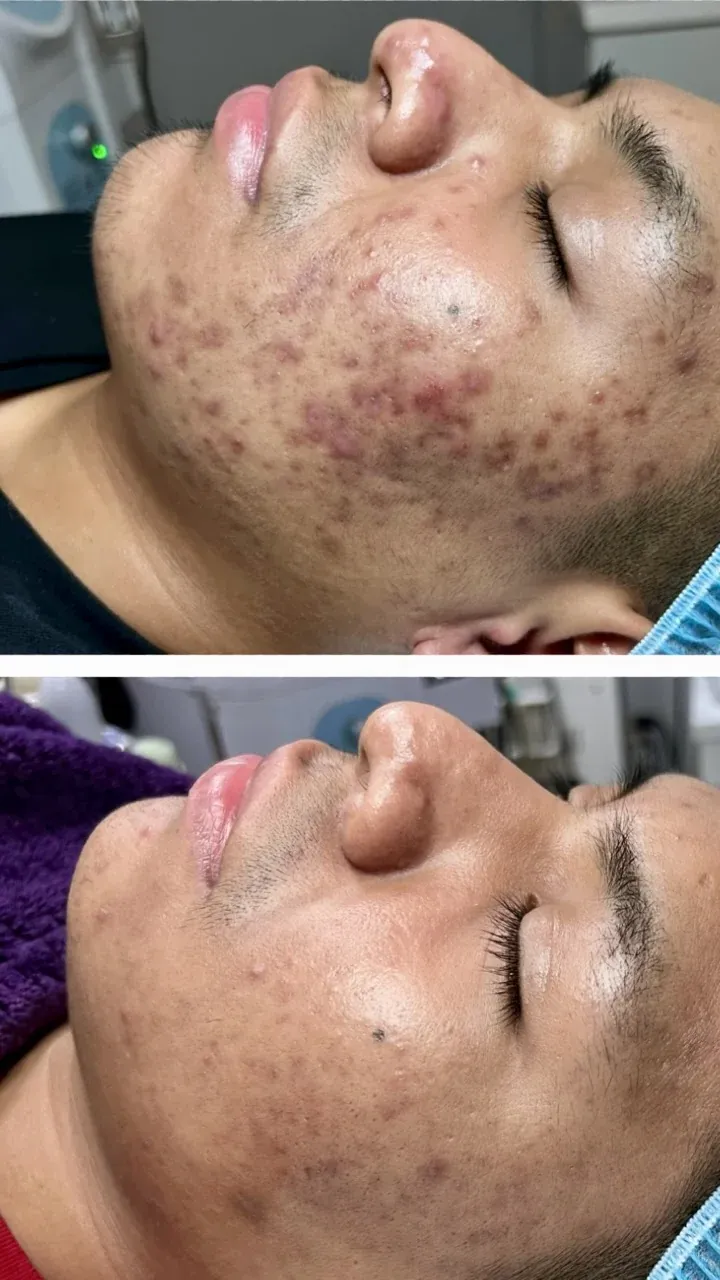
Microneedling improves the appearance of sunken acne scars, uneven texture, enlarged pores and fine lines. It can also help even out brown marks left by acne, together with daily sunscreen. The change is gradual, comes with a series of sessions, and results vary from person to person.
It is not a treatment for active breakouts, deep wrinkles or sagging skin, and on its own it does not treat melasma. With active acne, start with a deep-cleansing facial; for sagging skin, see HIFU; and for sun spots and melasma, see dark spots and melasma.
How it works
A device with very fine needles makes thousands of tiny, controlled channels in the skin. Your skin responds by repairing itself and producing new collagen and elastin over the following weeks and months, which can make it smoother and firmer. The channels close quickly and the surface of the skin stays intact, so it recovers sooner than after treatments that peel away the outer layer.
Acne scars by type
Most people have more than one type of acne scar, and the type shapes the plan.
- Rolling scars: wide, shallow dips with soft edges. They usually respond best.
- Boxcar scars: round or oval, with sharp edges. Shallow ones respond well; deep ones improve less.
- Icepick scars: narrow and deep, like small pits. They improve the least and may need other treatments from a dermatologist.
Acne scars usually need 3 to 6 sessions, 4 to 6 weeks apart. They soften and look shallower, but they do not disappear completely.
Step by step
- Consultation. We look at your skin, the type of scars or marks and your health history, and take photos.
- Preparation. We cleanse your skin and apply numbing cream. The whole visit takes about 60 minutes.
- Session. We adjust the depth to your skin and to each area. You may see pinpoint bleeding that stops quickly.
- Afterwards. We give you aftercare instructions, and you can go back to your day without makeup for 24 hours.
- Next session. Four to six weeks later, once your skin has healed. We retake the photo so you can see your progress.
Day-by-day recovery and results timeline
These are typical times; yours may differ.
- Same day: redness like a mild sunburn, warmth, tightness and mild swelling. In darker skin the redness can look darker rather than red.
- Days 1 to 3: the redness fades, and the skin may itch, feel tender or start to flake.
- Up to a week: dryness or light flaking, which a gentle moisturizer helps. Skip retinoids, acids and exfoliants during that week.
- Two weeks: stay out of direct sun and tanning, and wear sunscreen every day from the day after your session.
- A few weeks: the first changes in texture.
- Three to six months after your series: the full result, as collagen keeps forming.
Call us and see a doctor if you notice blisters, pus, spreading redness, bleeding that does not stop, or swelling that lasts more than a week.
Possible effects
- Expected, for a few days: redness, swelling, tightness, dryness, itching and flaking.
- Common: pinpoint bleeding during the session, and small bruises or crusts.
- Less common: darker or lighter patches, more likely in darker skin and usually temporary; a cold sore flare if you get cold sores; swollen glands; acne flares or tiny white bumps (milia); infection; and stinging when products go on in the first days.
- Rare: allergic reactions or lumps caused by products or by the metal of the needles, and lasting scars, including rows of small marks. The risk rises with poor technique or hygiene.
Contraindications and when to ask a doctor
We postpone it if you have active acne, a cold sore, an infection, a rash or an open wound in the area, a recent tan or sunburn, or plans to be in the sun in the two weeks after; and if you took isotretinoin (Accutane) in the last six months.
We do not do it during pregnancy, on skin prone to keloids or raised scars, or if you are allergic to numbing creams or to metals such as nickel.
Ask your doctor first if you are breastfeeding, take blood thinners or have a bleeding disorder, have diabetes or a weakened immune system, are being treated for cancer, or have eczema, psoriasis, vitiligo or another skin condition, or moles, warts or birthmarks in the area.
A spot or mark that changes should be checked by a dermatologist first, as should a mole that grows, changes shape or bleeds. We review your skin and health history at the consultation.
Microneedling, chemical peels and laser
This comparison is general information.
Chemical peel. An acid makes the outer layers of skin peel off, from light to deep. Light peels heal in about a week and are often chosen for tone and surface marks; medium and deep peels take one to three weeks and can darken or lighten the skin.
Fractional laser. It resurfaces the skin with heat and can give stronger results on scars, with longer downtime and a higher risk of dark marks in darker skin, so a dermatologist experienced with your skin type should do it.
Microneedling sits between the two: a short recovery and a gradual change.
Factors that influence the cost
We do not publish prices because the total depends on the area, on whether we are treating scars or texture, and on how many sessions your skin needs. Some people add a maintenance session once a year. Insurance usually does not cover acne scar treatment. At your consultation we give you the total cost before you start.
Questions about microneedling
Does microneedling hurt?
With numbing cream, most people feel pressure, light scratching or vibration. Areas over bone, such as the forehead and cheekbones, can feel stronger.
How many sessions will I need?
Usually 3 to 6, four to six weeks apart, depending on what we are treating and on your skin. At your consultation we tell you how many you need.
When will I see results, and how long do they last?
First changes usually show within a few weeks, and the full result three to six months after your series. It is not permanent: it fades slowly as your skin ages.
What will my skin look like the first few days?
Red and tight, like a mild sunburn, for one to three days. Light flaking can follow for up to a week, and you can wear makeup again after 24 hours.
Can it treat acne scars?
Yes, sunken acne scars are the most common reason to do it. Rolling and shallow boxcar scars usually respond best, and icepick scars improve less. Scars soften over a series of sessions but do not disappear completely.
Is it suitable for darker skin tones?
It is usually suitable for most skin tones; we adjust the depth and the sun care. In darker skin it can leave dark marks after a session, which are usually temporary. Daily sunscreen lowers that risk.
Does microneedling help with dark spots?
It can help brown marks left by acne fade, together with daily sunscreen; red or purple marks respond less predictably. On its own it is not a treatment for melasma, and a spot that changes should be checked by a dermatologist first.
How much does microneedling cost?
It depends on the area and the number of sessions. At your consultation we give you the total cost before you start.