Face
HIFU: skin tightening without surgery in Elizabeth, NJ
Focused ultrasound to tighten and firm sagging skin, without surgery or needles.
Elizabeth, New Jersey
- Session
- 45 to 90 min
- depending on the areas
- Sessions
- 1 to 3
- depending on the area and your skin
- Downtime
- Usually none
- redness for hours; tenderness that usually clears within two weeks
- Results
- 2 to 3 months
- when the first change usually shows; it can keep improving up to about 6 months
Location
134 Division St, Suite 1, Elizabeth, NJ 07201
By appointment only
We see clients from Elizabeth and from across North and Central New Jersey and New York: Newark, Jersey City, Paterson, Plainfield, Perth Amboy, New Brunswick, Freehold and Staten Island.
Get directionsWhat it helps with
HIFU improves the appearance of sagging skin on the face, neck and body: the jawline, a double chin, a loose neck, slightly dropped brows, fine lines, the abdomen and the arms. It works best on mild to moderate sagging. The change is gradual and modest, results vary, and some people see little or no change.
How it works
HIFU stands for high-intensity focused ultrasound. The handpiece focuses that energy at set depths under the skin, including the deep layer that a surgical facelift tightens, and heats tiny points there, aiming to spare the surface. The tissue contracts, and over the following months your skin can build new collagen that firms it. The result is more modest than a facelift’s.
Face, neck and double chin
HIFU can firm the jawline and the neck without surgery, and give the brows a modest lifting effect. On a double chin, it can help when the cause is mostly loose skin; it is not a fat-removal treatment. The change shows less, or may not show, with a BMI over 30, and very loose skin may need a surgeon’s evaluation instead.
For texture, acne scars or large pores, see microneedling; for breakouts or dull skin, a deep-cleansing facial. For eyelids, we use plasma energy, not HIFU.
Body: abdomen and arms
On the body, we use HIFU to firm loose skin on the abdomen and arms; it can also be applied above the knees. We do not offer it to reduce fat or lose weight, although other focused-ultrasound devices are made for that. Loose skin and fat are not always easy to tell apart, so we look at your case at the consultation.
Studies on the abdomen and arms are small, with modest improvements. They follow people for about six months, and some gains had started to fade by then.
Step by step
- Consultation. We review your skin and health history, photograph the area and tell you how many sessions you need.
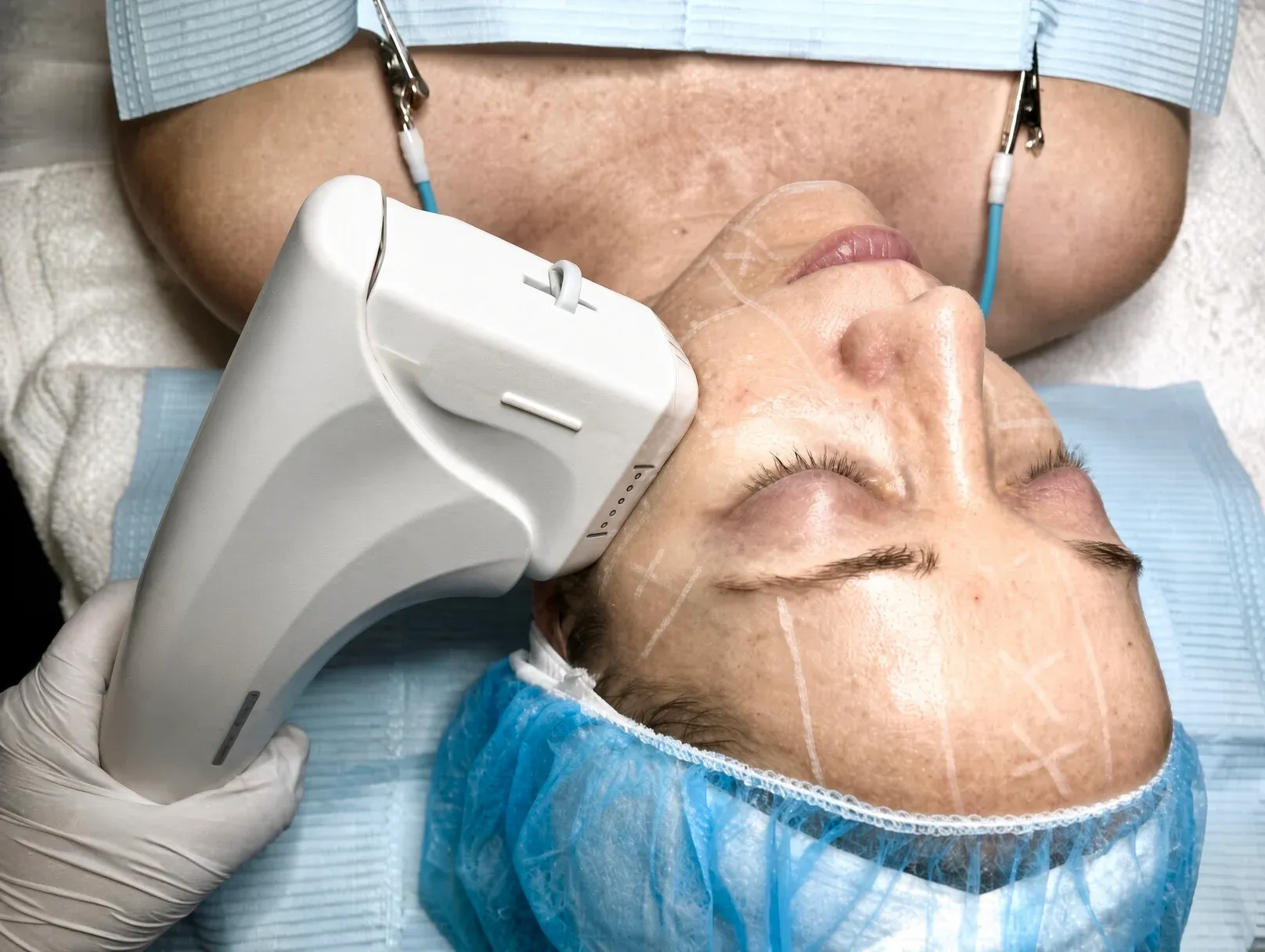
- Preparation. We cleanse your skin, apply a gel and draw guide lines to direct each pass.
- Session. It takes 45 to 90 minutes, depending on the areas. You feel brief pulses of heat, and sensitive areas can be treated at a lower setting.
- Afterwards. You can go back to your day and wear makeup the same day.
- Follow-up. We retake the photo to compare it with the first one.
Day-by-day recovery and results timeline
These are typical times; yours may differ.
- Same day: redness that fades within hours, and discomfort that can last up to two days.
- First week: mild swelling, which usually goes down within three days, and raised lines, if any.
- Up to two weeks: tenderness to the touch and, if any, bruises.
- Two to three months: when the first change usually shows. It can keep improving up to about six months.
- Up to about a year: how long the effect can last. It is not permanent, because your skin keeps aging.
Wear sunscreen every day and keep up your skin care routine.
Possible effects
- Common, mild and short-lived: redness, swelling and tenderness and, less often, raised lines or bruises.
- Uncommon: numbness, tingling or pain from an irritated nerve, and temporary weakness in a nearby muscle. They typically clear in two to six weeks.
- Also reported: burns that can scar, often linked to technique; darker patches, which took several months to clear in reported cases; loss of facial volume, sagging or asymmetry; nerve effects that last months; and eye injury or blurred vision when used near the eye, which is why we do not treat the eyelids with HIFU.
Call us and see a doctor if numbness or weakness does not improve, or if you notice any change in your vision.
Contraindications and when to ask a doctor
We do not do it during pregnancy or breastfeeding, on anyone under 18, with a pacemaker, defibrillator or other active implant, over metal implants in the area, or over open wounds, active acne or an infection. We also avoid the eyes, the eyelids and the under-eye area, the thyroid and keloids.
Ask your doctor first if you take blood thinners or have a bleeding disorder, an autoimmune disease, diabetes, epilepsy, Bell’s palsy, cold sores or a skin condition that may affect healing.
Tell us first about fillers in the area and when you had them, breast or other implants, and any recent facelift or laser treatment. For the abdomen, also tell us about a hernia, earlier surgery such as a C-section, liposuction or a tummy tuck, a piercing, very low body weight or major weight loss.
HIFU, surgery and radiofrequency
Surgical facelift. It involves incisions, stitches, sedation or general anesthesia and weeks of care. It gives the most dramatic result, which HIFU cannot match, and it suits marked sagging. HIFU has no incisions, usually no downtime and a modest result. It can postpone or complement surgery.
Radiofrequency. Both aim to firm mild to moderate sagging with heat. Ultrasound focuses it on points at set depths, while radiofrequency warms a broader volume of skin. In the small studies that compare them, neither clearly beat the other.
Factors that influence the cost
We do not publish prices because the total depends on the size of the area and the number of sessions your skin needs. Because it is a cosmetic treatment, insurance usually does not cover it.
Questions about HIFU
What are the downsides of HIFU?
The change is modest and gradual, takes months to show and is not permanent. The session can feel strong along the jaw and cause temporary redness, swelling or tenderness. Some people see little or no change, and very loose skin responds poorly.
Does HIFU burn fat or work for belly fat?
We do not offer it for that. We use HIFU on the body to firm loose skin, not to reduce fat or lose weight. At your consultation we tell you whether your concern is loose skin or fat.
When will I see results, and how long do they last?
The first visible change usually appears at two to three months and can keep improving up to about six months. Results can last up to about a year; they are not permanent.
Does HIFU hurt?
You feel short pulses of deep heat and some tingling. Studies usually score the discomfort as moderate, but it varies from person to person, and it can feel strong along the jaw and under the chin.
Does HIFU get rid of a double chin?
It can improve a double chin that comes mostly from loose skin, and the change is modest. It is not a fat-removal treatment. At your consultation we tell you whether HIFU suits you.
How many HIFU sessions will I need?
Between 1 and 3, depending on the area and your skin. At your consultation we tell you how many you need.
How much does a HIFU session cost?
It depends on the area and the number of sessions. At your consultation we give you the total cost before you start.